
Bathroom brands we fit in Reading
We work on a fit-only basis across Reading, which means we install the bathroom products you've already chosen — from a showroom, a designer's specification, or your own research — rather than selling you a fixed catalogue of our own. Reading is one of the larger towns in our working area, and its housing reflects that scale: dense Victorian and Edwardian terraces close to the centre and around the University of Reading, inter-war and post-war suburban semis and detached houses, newer apartment and town-centre regeneration schemes, and larger detached properties in the outer villages and commuter suburbs on the edge of the borough. That spread means we see products specified at very different levels across the same town, sometimes in the same week — a period-style suite going into a terraced house near the university one day, a minimal digital shower system going into a new regeneration apartment the next. Across the projects we work on, a recurring set of brands turns up again and again, and we've built our fitting process around the specific detail each one needs.
The fit-only model, explained
Fit-only means exactly what it says: the labour and installation expertise, without us also supplying or marking up the products. You choose your sanitaryware, brassware and tiles through whichever route suits you — a bathroom showroom, an online retailer, a designer's specification, or a brand's own stockist — and we fit them to the standard they're designed for. This works well across Reading's range of property types, whether the specification has come from a designer for a larger house out in one of the commuter villages, been picked out at a showroom for a Victorian terrace refit near the university, or chosen more simply for a suburban semi or a town-centre regeneration apartment. It also means the quote you get reflects labour and fitting complexity honestly, rather than bundling in a retail margin on the products themselves. Where it matters most is in the detail: a concealed cistern frame, exposed period-style pipework, or a frameless glass screen all need to be fitted correctly for that specific product, and we work through exactly what's been specified before a wall closes up or a screen goes in.
Brands we fit
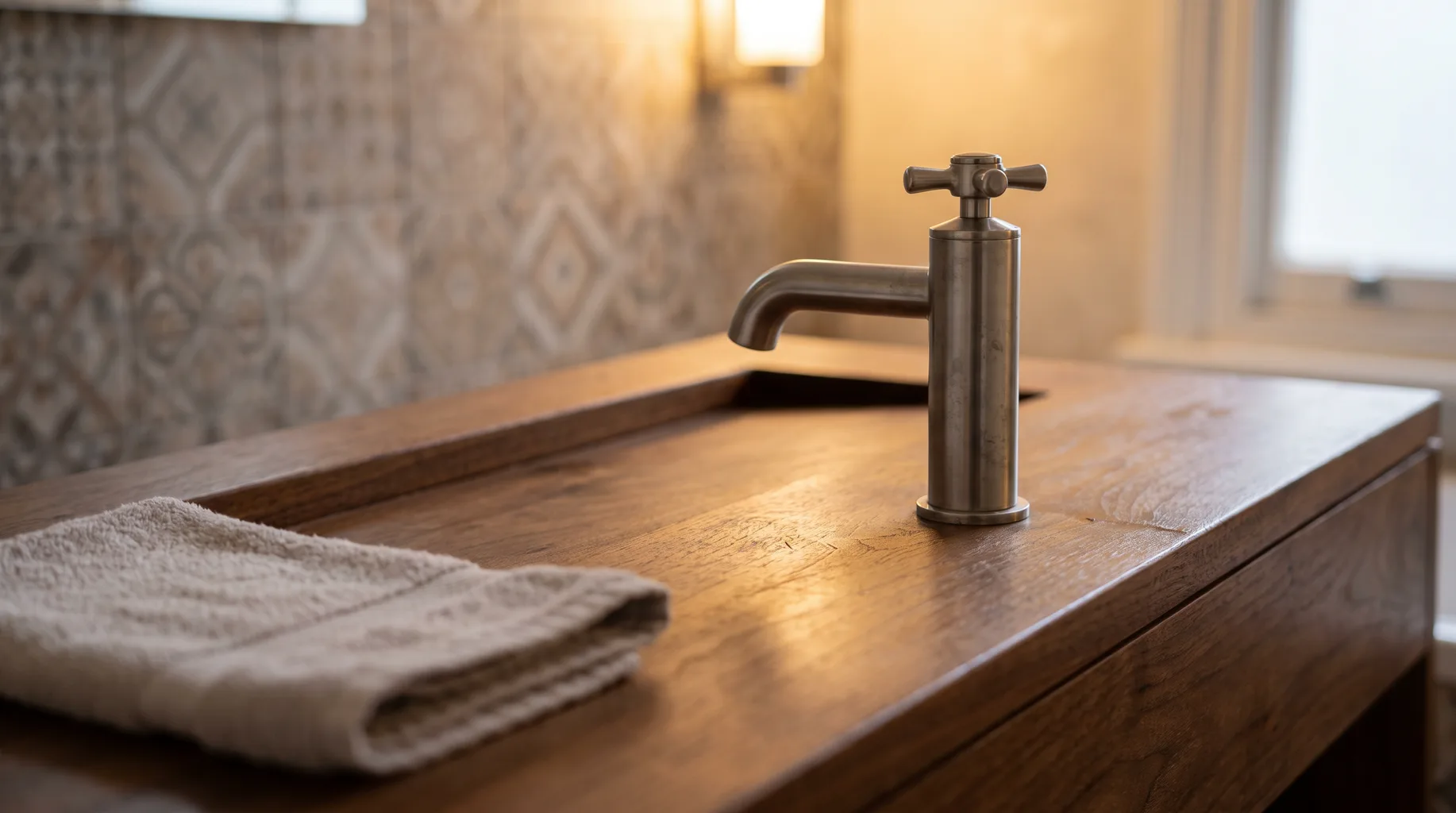
Geberit concealed cisterns and wall-hung WCs are among the sanitaryware we fit most often in Reading — correct frame selection and structural fixing matter more here than with most brands, because the cistern and pan weight sit entirely on the carrier frame rather than the wall tiles, which is a real consideration in the dense Victorian and Edwardian terraces near the centre where wall construction varies property to property. TOTO's Washlet and Neorest ranges turn up on some of the more technically involved projects we fit, because the electronics sit inside the fixture itself — a Washlet seat adds to a conventional pan, while a Neorest is a single integrated unit replacing the pan, cistern and seat entirely, and knowing which one's been ordered changes how the room is first-fixed. On brassware, GROHE covers a wide span of what we install in Reading, from thermostatic shower valves and mixer taps on more straightforward refits through to Rapid SL cistern frames and digital shower products on higher-specified jobs, which is why we work through exactly what's been chosen at survey rather than treating any one brand name as a single fitting job. Dornbracht sits at the top end of the projects we see, mostly in the larger detached properties out toward the villages on the edge of the borough, where the margin for error is smaller — a scuff on a brushed finish or a rough-in set a few millimetres wrong is far more visible on a design-led brassware set than on a mainstream one. For sanitaryware with a finer, sharper profile, Laufen's SaphirKeramik material lets basins and pans be produced with noticeably thinner rims than standard vitreous china, which means handling and sequencing on site get more attention than a heavier, more conventional range would need. And where a Reading property leans traditional — which is common in the terraces near the university — Lefroy Brooks's exposed pipework, cross-head handles and period-inspired profiles mean the pipe runs, brackets and wall fixings are set out and finished to be looked at, not hidden, since every joint stays visible once the room is finished.
Matching the fit to the property
Because Reading's housing stock spans such a wide range — Victorian and Edwardian terraces, inter-war and post-war suburbs, newer apartment schemes and larger outer-village houses — the brand and product mix we see varies as much by property type as by homeowner taste. A Geberit concealed cistern frame that fixes easily into a modern stud wall in a post-war suburban semi needs a different structural approach in a solid Victorian masonry wall near the university. Crosswater's concealed valves and digital shower controls, designed to disappear into the wall or worktop rather than sit proud of it, depend on wall build-up and pipework depth being right well before a tiler arrives — a detail that matters as much in a tight period terrace as a newer regeneration apartment. Porcelanosa's large-format porcelain tiling, dense and dimensionally precise, punishes an uneven substrate more visibly than a smaller, more forgiving tile, so whichever type of Reading property it's going into, the floor or wall gets checked and prepared flat first. That's the value of working through exactly what's specified at survey stage: the brand tells us what the product needs, and the property tells us how to deliver it.
Frequently asked questions
No. We work fit-only, which means you choose and supply your own sanitaryware, brassware and tiles — through a showroom, designer or retailer — and we handle the installation to the standard those products need.
Geberit and TOTO sanitaryware, and GROHE brassware, come up most frequently across the range of properties we work on in Reading. We also regularly fit more design-led or period-specific brands such as Dornbracht, Laufen and Lefroy Brooks, depending on the property and the specification.
In most cases, yes — we work through the specific installation requirements of whatever's been specified at survey stage. If a product has an unusual fixing or frame requirement, we confirm it before anything is ordered rather than discovering it on fitting day.
The product and its fixing requirements stay the same, but the property changes how we deliver it — wall construction, access and floor build-up all vary between a Victorian terrace near the university, a post-war suburban house and a newer town-centre regeneration apartment, and we confirm the detail for your specific property at survey.
Yes. A lot of the specification we fit in Reading has already been through a showroom consultation or designer before we're brought in at survey stage, and we're used to working from an existing specification rather than starting from scratch.