
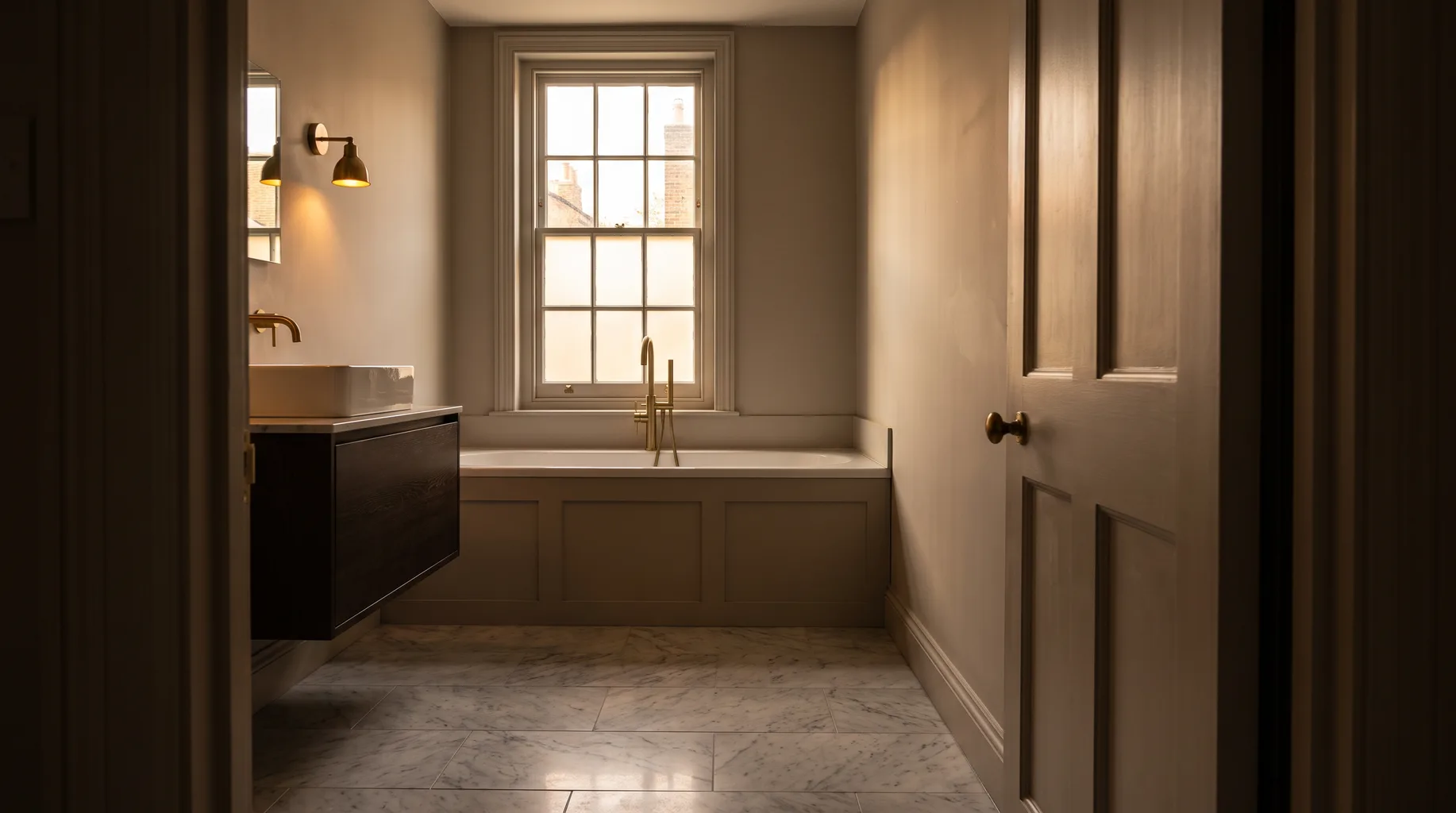
Bathroom installation cost in Eton
Fit-only bathroom installation in Eton starts from £3,500 — that's the labour and fitting cost for a straightforward replacement using your own supplied products, with the waste and water staying roughly where they already are. What pushes the number up from there is almost never the brand of tap or tile you choose; it's the structural work, the plumbing, and in Eton's case, the logistics of actually getting the job done. Eton is a small, historic town, and its housing reflects that: a concentration of period properties along and around the High Street, many dating from the Georgian and Victorian periods, with narrower frontages and more compact floor plans than the larger detached houses found further out in Berkshire. Narrow staircases, period door openings and limited off-street parking all affect how materials move in and waste moves out, and that access picture is one of the things that genuinely does shape the cost of a job here, alongside the usual drivers of waste position, wet room versus tray, and material choice.
Install price ranges from £3,500
The £3,500 starting point covers fit-only installation of a bathroom where the room's footprint and the position of the waste and supply pipes stay broadly as they are. As the scope grows — a reconfiguration, a wet room, higher-specification finishes, or an access route that needs extra planning — the fit-only price moves up from there. We don't publish a single all-in average because two bathrooms of the same size can cost very differently depending on what's involved below the surface and around the property: whether the waste run has to move, what the floor and walls are made of underneath, how many trades the fit actually needs, and — particularly relevant in a town like Eton — how straightforward it is to get materials to the room and waste away from it. A fixed quote only comes after survey, once we've seen the property and confirmed all of that.
What changes the cost
A handful of decisions account for most of the difference between a £3,500 job and a considerably larger one. Moving the waste run — repositioning a WC or shower away from its existing soil pipe — is one of the biggest single cost drivers, because it usually means opening up a floor or chasing a wall rather than connecting back to what's already there, and in an older property that can mean working around original joists and floorboards rather than a modern screeded slab. Choosing a wet room over a shower tray is another: a wet room needs a formed and tanked fall built into the floor structure, which is a different scope of work to dropping a tray onto an existing subfloor. Material choice matters too — natural stone such as marble, limestone or travertine typically needs more careful substrate preparation, different adhesives and more cutting time than porcelain, and that additional handling is reflected in the fit-only price even before you account for the material cost itself. None of these are reasons to avoid a particular spec; they're simply the things we cost properly at survey rather than guessing at.
Repairs pricing
Not every job starts from scratch. If you've got an existing bathroom with a specific fault — a leak, a failed seal, a fitting that's come loose — repairs start from £200. An emergency call-out carries a £500 minimum, reflecting the cost of getting a fitter to you outside a normal scheduled visit, which in a town with limited off-street parking can itself take a little more planning than it would elsewhere. One thing worth being clear about: we don't offer regrouting as a standalone repair service. If the grout has failed to the point it needs addressing, that's usually a sign of a wider issue with the tiling or substrate underneath, and we'll talk through what's actually needed rather than patching over a symptom.
How Eton's housing stock affects typical specification
Eton's identity as a small, historic town shows up directly in what a typical installation involves here. The concentration of period properties along and around the High Street — many Georgian or Victorian, with narrower frontages and more compact floor plans than the larger detached houses found further out in Berkshire — means two things in practice. First, access: narrow staircases, period door openings and limited off-street parking affect how materials move in and waste moves out, and that logistics picture is priced in at survey rather than assumed. Second, specification: a more compact floor plan often steers the sensible choice toward space-efficient fixtures — a wall-hung vanity rather than a floor-standing unit, a frameless shower screen rather than a bulkier framed enclosure — simply because there's less room to work with than a larger detached property would offer. That doesn't make every Eton job automatically more expensive than the same job elsewhere; a straightforward like-for-like replacement costs the same regardless of the property. What it does mean is that access and compact floor plans are genuinely factored into the quote here in a way they might not need to be in a larger, more modern house, and the survey is where we confirm exactly how for your property.
Frequently asked questions
Fit-only installation starts from £3,500 for a straightforward replacement where the waste and water stay roughly where they are. The final figure depends on the scope confirmed at your £125 survey, including any reconfiguration, wet room work, material handling and access logistics involved.
Not automatically. A like-for-like replacement costs the same regardless of the property. What Eton's narrower frontages, narrow staircases and limited off-street parking do affect is how materials move in and waste moves out, which is factored into the quote at survey rather than assumed.
Repositioning a WC or shower away from its existing soil pipe usually means opening up the floor or chasing into a wall to run new pipework, rather than connecting back to an existing waste point. In an older Eton property that can also mean working around original joists and floorboards, which is priced in at survey once we've seen what's underneath.
Yes, generally. Natural stone such as marble, limestone or travertine needs more careful substrate preparation and more cutting and handling time than porcelain, which adds to the fit-only labour cost on top of any difference in material price.
Repairs start from £200. An emergency call-out has a £500 minimum. We don't offer standalone regrouting — if grout has failed, it's usually a sign of an underlying tiling or substrate issue that needs addressing properly.