
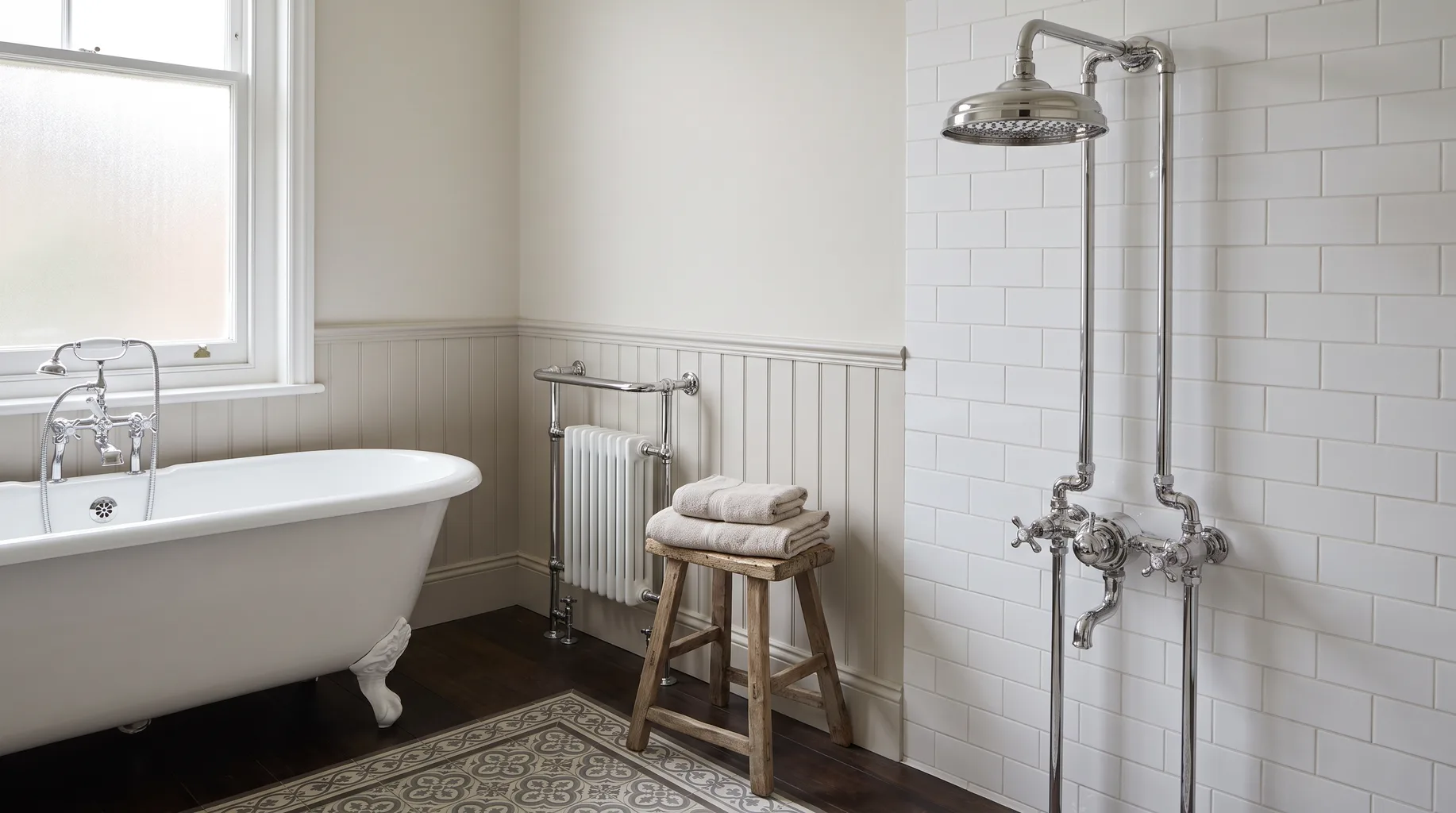
Lefroy Brooks Installation
Lefroy Brooks's traditional-style taps, shower valves and sanitaryware are built around exposed pipework, cross-head handles and period-inspired profiles rather than the concealed, minimal fittings most modern brassware favours. Fitting it well means the pipe runs, brackets and wall fixings are set out and finished to be looked at, not hidden — every joint, bracket and pipe run visible once the room is finished.
What we install from the range
We fit Lefroy Brooks's bath and basin mixers, exposed thermostatic shower valves and fixed shower arms, bath shower mixers with telephone-style handsets, and traditional sanitaryware including basins, WCs and roll-top style baths. The range covers both deck-mounted and wall-mounted configurations, finished in chrome, nickel, aged brass and several darker metal finishes.
The brassware and sanitaryware we fit from Lefroy Brooks is specified and purchased by the client, usually through a bathroom showroom or specialist retailer. We don't supply Lefroy Brooks products — our work starts once the pieces are on site, ready to be set out, fixed and plumbed in. Several collections within the range also include matching accessories — robe hooks, towel rails and shelving — finished to the same standard as the taps, which we fit as part of the same first-fix and final-fix sequence.
Installation requirements
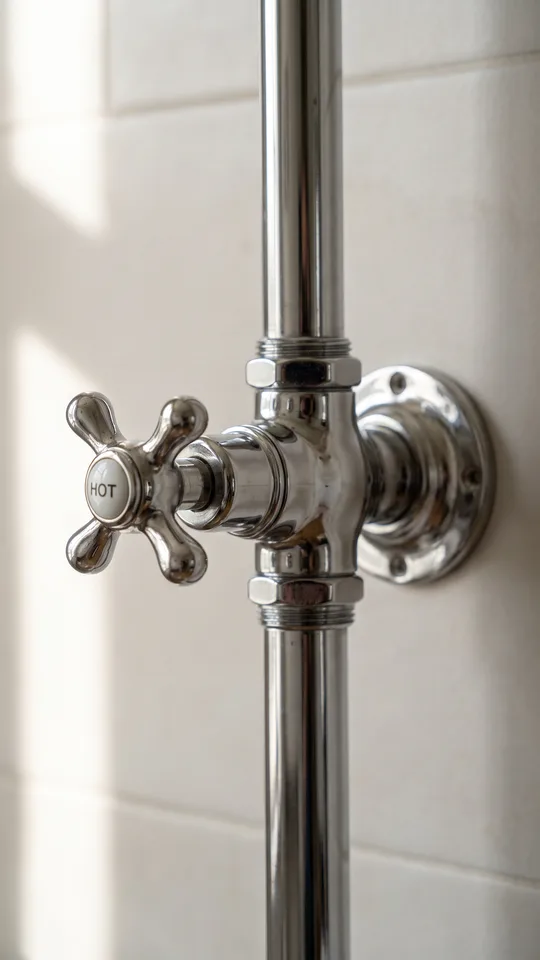
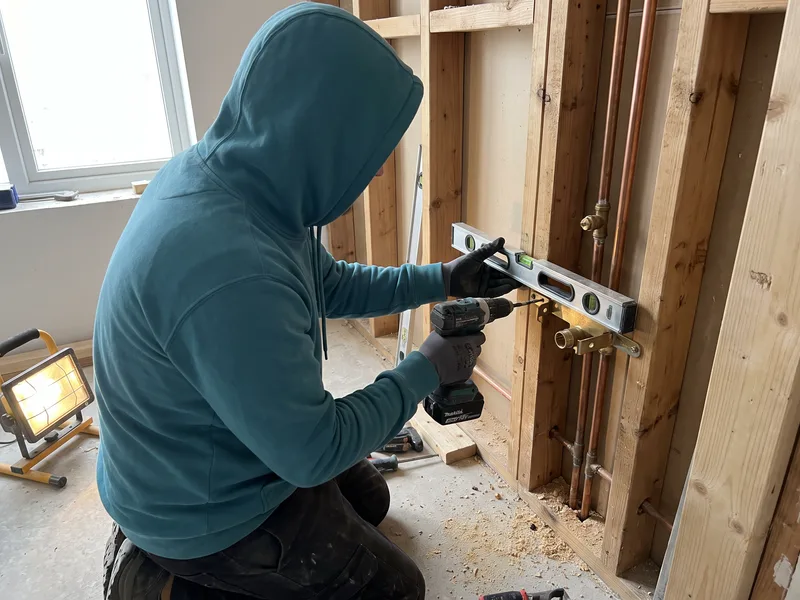
- — Exposed pipework set-out: visible pipe runs and brackets are planned and fixed square and level at first fix, since they can't be hidden or corrected once tiling and decoration are complete.
- — Wall build-up depth: wall-mounted taps and shower valves need the finished wall thickness and tile depth confirmed before first fix, so the valve body sits at the correct projection.
- — Water pressure and flow: exposed thermostatic valves and larger fixed shower heads need adequate pressure and flow to perform properly, checked at survey against your existing system.
- — Finish protection: aged brass, nickel and other decorative finishes are protected with non-marking jaws and clean jointing methods to avoid tool marks and flux staining during fitting.
- — Fixing points for traditional sanitaryware: roll-top baths and period-style basins often need specific bracket or leg fixings confirmed against the floor or wall construction before installation.
What to check on delivery
Check that the finish, handle style and configuration (deck-mounted versus wall-mounted, for example) match your order precisely — Lefroy Brooks offers several closely related ranges and finishes that look similar in a brochure but aren't interchangeable once pipework is set out to a specific model. Inspect the brassware for scratches, tool marks or finish inconsistencies before we begin, since exposed fittings show every mark clearly once installed. Confirm all fixing kits, wall plates and any matching accessories are present, as traditional ranges often supply these as separate components rather than a single boxed unit.
Common issues we prevent
The fault we most often correct on other people's exposed pipework is misaligned or unlevel pipe runs — visible on a traditional valve in a way that's forgiven on a concealed one. Once tiling and decoration close around a bracket, an out-of-true pipe run can't be adjusted without opening the wall back up, so we set it out precisely at first fix, checking against the actual valve and basin or bath position rather than a generic template.
The second is insufficient pressure reaching a large fixed shower head, where a valve performs well on paper but disappoints in use because the existing system can't support the flow it was designed around. We flag this at survey, before the valve is purchased, so pressure or pump requirements are known in advance rather than discovered at first use.
Working within period and traditional-style bathrooms
Lefroy Brooks is frequently specified in period properties or rooms built to recreate a traditional style, which brings its own planning considerations beyond the brassware itself. Older walls are rarely perfectly flat or square, so exposed pipe brackets are set out to read as level and consistent to the eye, even where the wall behind them isn't — a different discipline to fixing against a modern, true stud wall.
We also coordinate exposed pipework with the room's wider finishes — tiling height, skirting detail and any panelling — so pipe runs sit in proportion with the room rather than crossing awkwardly through a tile joint or feature detail. This is agreed at survey, using the actual brassware model and the room's finished layout, before first fix begins.
Protecting decorative finishes through to handover
Aged brass, nickel and other decorative finishes are fitted relatively late in a project, once tiling and first-fix trades are complete, but the room is rarely finished the moment the taps go on — decorators, electricians fitting lights, and the final clean are often still to come. We fit protective sleeves or film to exposed brassware immediately after installation and agree with other trades working nearby that it stays in place until the room is genuinely finished.
This matters more with a decorative finish than a standard chrome tap, since a solvent spill, a dropped tool or an abrasive cleaning product used by mistake during final clean can mark a nickel or aged brass surface in a way that isn't easily corrected. Taking the time to protect it properly at the point of fitting avoids a conversation about damage that happened after our work was complete.
Frequently asked questions
Both are available across the range. Exposed, traditional-style pillar taps and bath shower mixers are fitted with visible pipework and brackets, which we set out and fix at first fix so the finished pipe runs sit square and level before tiling closes around them.
Deck-mounted taps are generally straightforward, but wall-mounted and exposed shower valves need the wall build-up and tile thickness confirmed in advance, since the valve body and pipework have to land at the correct finished depth. We check this at survey before first fix.
Traditional thermostatic and exposed shower valves generally need adequate mains or pumped pressure to perform as intended, particularly on larger fixed heads. We measure your system's pressure and flow at survey and flag any pump or boost requirement before you commit to a specific valve.
Yes — finishes such as aged brass, nickel and polished finishes mark more easily from grip wrenches, flux and installation handling than a standard chrome tap. We use protective jaws and clean, flux-free jointing techniques throughout so the finish reaches final handover undamaged.
Yes — Lefroy Brooks is sold through a network of bathroom showrooms and specialist retailers as well as directly, and you're free to buy through whichever route suits you. We fit what you've purchased; we don't sell Lefroy Brooks products ourselves.
No. We are an independent fit-only installer with no commercial relationship with Lefroy Brooks. We install the brassware and sanitaryware our clients buy themselves.
Yes, this is common and not a problem — traditional-style brassware is frequently paired with sanitaryware from another manufacturer. What matters is confirming tap hole centres, deck thickness and basin or bath cut-outs match the brassware you've chosen before anything is ordered.
Exposed pipework and traditional fittings generally take longer to set out and fix than concealed, modern equivalents, because every pipe run is visible and has to be finished square and level by hand. We allow for this at the planning stage rather than treating it as a standard brassware fit.
Limescale builds up on any brassware in a hard water area, and decorative finishes can be more sensitive to the wrong descaling product than standard chrome. We'd point you to Lefroy Brooks's own cleaning guidance for the specific finish you've chosen, since ongoing maintenance sits outside our installation role.
Install My Bathroom is an independent fit-only installer. We are not affiliated with, sponsored by, or endorsed by Lefroy Brooks; all product names and trademarks belong to their respective owners.