

What to Check When Your Bathroom Is Delivered
Open every box before we arrive, not after. Check for cracks, chips and scratches, confirm the model, size and finish match your spec, count every fixing kit and ancillary part, and note the batch number on tiles and stone. A problem caught at delivery is a free swap; one caught mid-install is a delay you pay for.
Under a fit-only arrangement, the goods are yours from the moment they leave the retailer — we install what arrives, and a delay or a return visit caused by a missing, damaged or incorrect item is chargeable because it's labour we can't use productively elsewhere that day. None of this is about catching anyone out; it's simply that the delivery van is the easiest point in the whole project to put something right, because the item hasn't been cut, bonded, wired or sealed into the room yet.
The delivery-day checklist
- 1 Match the delivery note to your order. Check model numbers, colours, sizes and quantities line by line before the driver leaves — once they've gone, a shortage becomes a phone call and a wait rather than an on-the-spot fix.
- 2 Inspect the outer packaging first. Crushed corners, punctured cardboard or a wet pallet are all signs the item inside may have taken an impact in transit, even if the box looks intact from the other side.
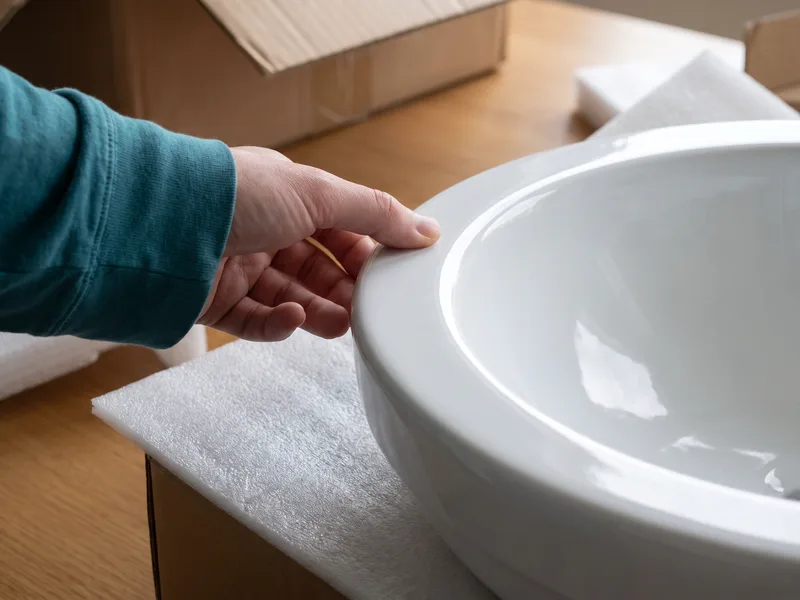
- 3 Unbox sanitaryware fully and check all visible faces. Run a hand along rims and edges — hairline cracks in vitreous china and chips on a WC pan or basin edge are easier to feel than see under indoor lighting.
- 4 Check brassware finish and consistency. Brushed brass, matt black and polished nickel finishes should look consistent across every tap, shower valve and accessory in the room — compare items against each other, not just against a sample in a showroom.
- 5 Confirm the exact variant, not just the product name. Basin tap-hole configuration, WC pan projection, bath length and shower tray waste position all have multiple variants under the same product name — the wrong one can mean a wall or stud position that doesn't work.
- 6 Count every ancillary part. Concealed cistern frames, flush plates, waste traps, overflow kits, tap connector hoses and fixing screws are easy to lose once separated from their box — keep each with its matching item.
- 7 Check tile and stone batch numbers. Written on the box label — every box for a single room should carry the same batch, and if a shortfall means a later top-up order, flag it before any tile is laid, not after.
- 8 Inspect shower screen and mirror glass for edge chips. Corners and cut edges take the force of an impact — a small chip there can propagate into a crack once the glass is under load from fixings or a door hinge.
- 9 Repack and store everything securely until install day. Original packaging, kept flat and off a garage floor, protects far better than a blanket — and keep the room dry and above freezing if it includes electrical items such as a shower toilet or digital shower controller.
- 10 Photograph anything you're unsure about. A dated photo of a mark on arrival is the clearest evidence if you need to raise it with the retailer later, and it lets us look at it with you before we commit to fitting.
What to check, by product type
| Product | Specific checks |
|---|---|
| WC pan / basin | Rim and base for hairline cracks, glaze consistency, projection and fixing centres match the survey measurements. |
| Bath | Surface for scratches, feet and frame kit included, waste and overflow position matches drawings, correct length and tap-hole layout. |
| Brassware | Finish consistent across all pieces, cartridge and flow controls move freely, all fixing and connector hoses present. |
| Concealed cistern and frame | Frame height matches the finished floor level agreed at survey, flush plate finish correct, actuator and seals included. |
| Tiles / stone | Batch number consistent across all boxes, sufficient quantity plus wastage allowance, edges undamaged, correct size and finish. |
| Shower screen / enclosure | Glass free of edge chips, correct width and handing, all brackets and seals present, profile finish matches brassware. |
| Vanity units and mirrors | Carcass square and undamaged, soft-close mechanisms working, mirror glass free of silvering defects, electrics present on illuminated mirrors. |
Why this matters more than it seems to
A damaged WC pan, a wrong-size bath or a missing waste kit discovered on the morning of second fix doesn't just lose you that item — it can stall the whole programme, because the team on site that day is scheduled against other work the following week. We'll always try to work around a gap where we can, finishing other parts of the room first, but a missing concealed cistern frame or the wrong basin tap-hole configuration can mean an entire stage has to wait.
This is also why we confirm exact model numbers and carrier frame requirements with you at survey stage, before you order — it's far cheaper to catch a mismatch between what you're planning to buy and what the room actually needs on paper than to discover it once the item is unpacked and the receipt's long gone.
Common delivery problems, and what to do about each
A wrong item is the easiest to spot and the easiest to resolve, provided it's caught before the box is broken down and the packaging thrown away — most retailers want the original packaging back for a collection and swap, and without it a return becomes far harder to argue. Keep the box, the polystyrene corners and any protective film until the correct item is confirmed on site and fitted.
A damaged item is slightly more involved, because the damage isn't always obvious under a single light source. We'd suggest checking visible faces under both natural daylight and the room's existing artificial light, since a hairline crack in white vitreous china can be almost invisible under one and obvious under the other. Photograph any mark you're unsure about, including a wide shot showing the item's position and a close-up of the mark itself with something for scale, such as a coin or tape measure, next to it.
A finish mismatch is more subtle still — brushed brass from one manufacturer can read warmer or cooler than brushed brass from another, and even within a single product range, taps and accessories ordered at different times can come from different production runs with a slightly different tone. Lay every brass or black item for the room out together before accepting delivery, rather than checking each piece in isolation as it's unpacked.
A missing part is the quietest problem of the four, because nothing looks wrong until the day it's needed — a waste kit left in a separate, smaller box that got set aside, or a fixing template that was packed loose in a larger delivery and never opened. Checking the parts list against the box contents on delivery day, not assuming everything listed is present because the main item arrived intact, is what catches this before it becomes a hold-up on-site.
Staging deliveries across a larger project
On a full re-fit with multiple suppliers — sanitaryware from one retailer, tiles from another, a vanity unit from a specialist furniture maker — deliveries rarely all land on the same day, and storing everything safely until it's needed becomes part of the planning. We agree a delivery schedule against the installation programme at survey stage, so first-fix items such as the concealed cistern frame arrive ahead of strip-out, and finishing items such as mirrors and accessories arrive closer to handover, rather than everything turning up at once and competing for space in a house that's also being lived in.
Where space is tight, a spare room, garage or even a neighbour's outbuilding temporarily pressed into service works better than leaving boxes in a hallway that's also meant to stay clear for daily access — and anything left outside, even briefly under a gazebo or in a garden store, needs checking for damp ingress before it's brought in and fitted.

Sources and standards
Tile and natural stone shade and batch consistency referenced here follows BS 5385 (wall and floor tiling), which recommends laying from a single batch wherever possible. Your statutory rights over faulty, damaged or misdescribed goods sit with the retailer under the Consumer Rights Act 2015, separate from our fit-only installation guarantee.
Who to contact, and how quickly
Most online retailers and showrooms give a short window — often 24 to 48 hours — to report damage or shortages before their standard returns process becomes more involved, so the sooner an issue is logged, the simpler it usually is to resolve. Keep the order confirmation and delivery note together with any photographs, since most retailers ask for the order reference before they'll act on a claim. If a courier rather than the retailer caused visible damage to packaging, note it on the delivery paperwork at the point of signing where possible — a signature marked "unchecked" or "damaged packaging" carries more weight with a claim than a clean signature followed by a complaint days later.
We're glad to look at anything you're unsure about and give an honest opinion on whether it's fit to install, but the contractual relationship for a faulty or incorrect product sits between you and the seller, not us — we didn't sell it, so we can't authorise a return or refund on your behalf. What we can do is make sure nothing goes into the wall or floor that we wouldn't be happy to put our name to.
Related services
Related guides
Areas served
Frequently asked questions
The retailer or manufacturer you bought from, under the Consumer Rights Act 2015. We'll always point out damage we find, but checking the goods and raising a claim with the seller is on you as the buyer — the sooner it's reported, the easier the replacement.
Unbox and inspect, yes — but repack carefully in the original packaging with any foam or corner protection back in place. Loose sanitaryware stored unpacked in a garage or hallway is far more likely to pick up a chip before install day.
We stop and show you before fitting anything we're not satisfied with — a hairline crack in a basin or a chipped WC pan rim gets flagged on the spot. Fitting a damaged item and discovering it later makes a return much harder to argue.
Yes. Porcelain and natural stone are manufactured in batches, and shade or tone can vary noticeably between them. Mixing batches across a floor is one of the most common causes of a tiling job looking patchy despite being laid perfectly.
Keep them with their matching item, in the box, not loose in a drawer. A concealed cistern frame, flush plate, waste trap or tap connector hose going missing between delivery and install day is one of the most common causes of a delayed second fix.
We're happy to look over anything already on site when we arrive for survey or start of works, but goods are usually delivered to you well before that. Checking on the day, while the driver is still there, is the only point you have real leverage with the courier or retailer.
Written by the Install My Bathroom installation team — 30 years fitting high-end bathrooms.
Last updated: 2026-10-05